
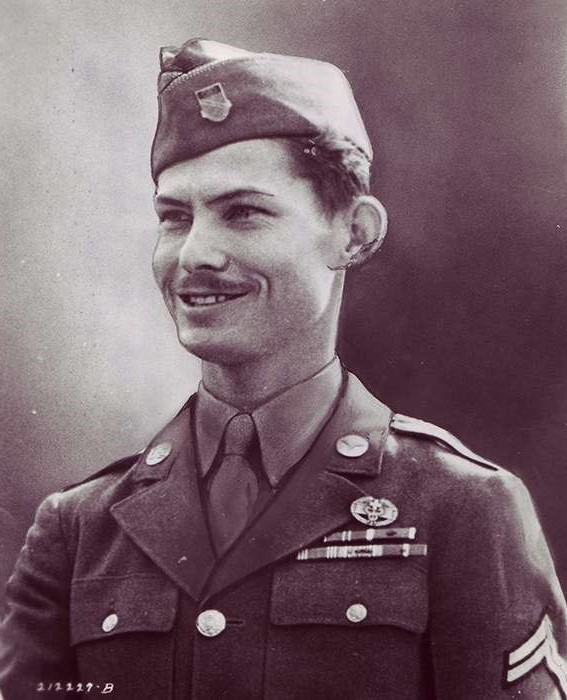
Desmond Thomas Doss (1919–2006) was an American army medic who would not carry a weapon – and who received the Medal of Honor for saving the lives of many wounded soldiers under fire on Okinawa in 1945. Working alone on top of the Maeda Escarpment, the cliff the soldiers called Hacksaw Ridge, he lowered man after man to safety on a rope. He was the first conscientious objector ever awarded the Medal of Honor.
A carpenter’s son from Lynchburg
Doss was born on 7 February 1919 in Lynchburg, Virginia, the son of a carpenter. His mother brought him up as a devout Seventh-day Adventist: he kept the Sabbath, did not eat meat and believed that he must not kill. He left church school after the eighth grade to work at a lumber company and help support the family through the Great Depression, and before the war he worked as a joiner at the shipyard in Newport News.
His shipyard work entitled him to a deferment from the draft, but he turned it down because he wanted to serve. He was inducted into the army on 1 April 1942 and trained at Fort Jackson, South Carolina, with the 77th Infantry Division. Because he would not carry or use a weapon, he became a medic – an aid man with the 2nd Platoon, Company B, 1st Battalion, 307th Infantry Regiment. In August 1942 he married Dorothy Schutte.
Guam and the Philippines, 1944
The 77th Division went into action in the Pacific in 1944, landing on Guam in July and then fighting on Leyte in the Philippines. With his platoon in both campaigns, Doss went out to the wounded wherever they fell, and he was twice awarded the Bronze Star with the “V” device for valour in aiding wounded soldiers under fire.
Hacksaw Ridge, Okinawa
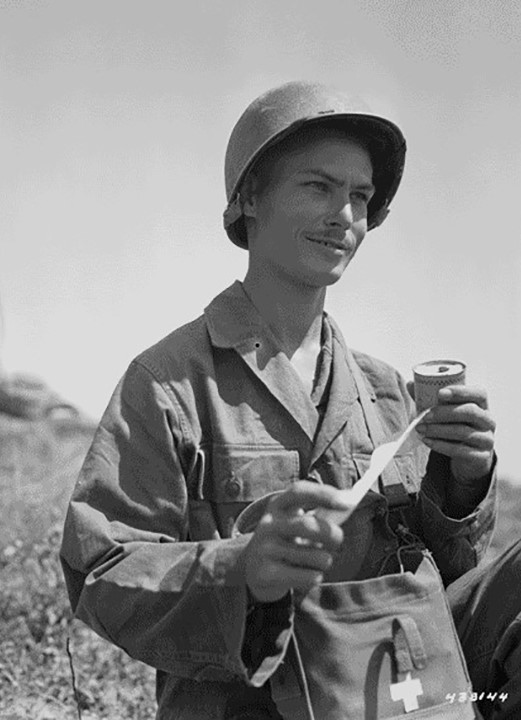
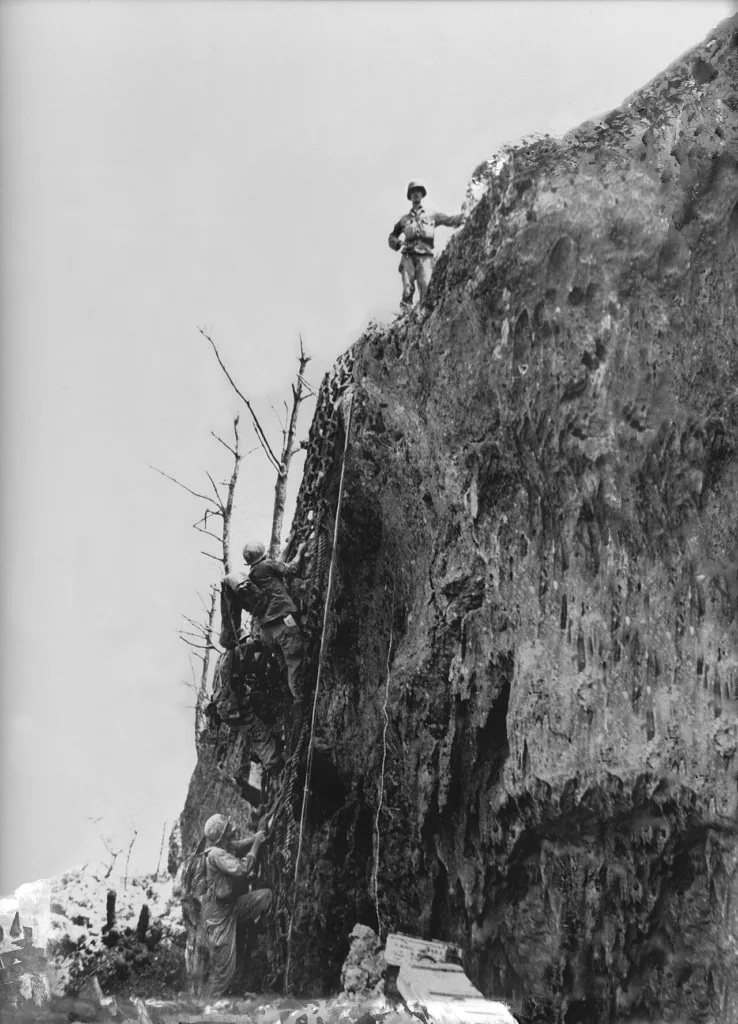
In the spring of 1945 the 77th Division fought on Okinawa, the last great battle of the Pacific war. Near Urasoe-Mura the 1st Battalion had to assault the Maeda Escarpment, a jagged cliff about 400 feet high. As the troops reached the top, heavy artillery, mortar and machine-gun fire struck them, causing about 75 casualties and driving the rest back down.
Doss refused to take cover. He stayed on the fire-swept summit with the wounded, carried them one by one to the edge of the cliff and lowered them on a rope-supported litter down the rock face to the men below. His Medal of Honor citation records the days that followed: on 2 May he rescued a wounded man 200 yards in front of the lines; two days later he advanced through a shower of grenades to within eight yards of a Japanese-held cave to dress the wounds of four men and then made four trips under fire to carry them back; on 5 May he gave plasma to a wounded artillery officer while shells fell close by, and later that day crawled to a soldier lying 25 feet from an enemy position and carried him 100 yards to safety. In all, Doss is credited with saving between 75 and 100 men.
21 May 1945
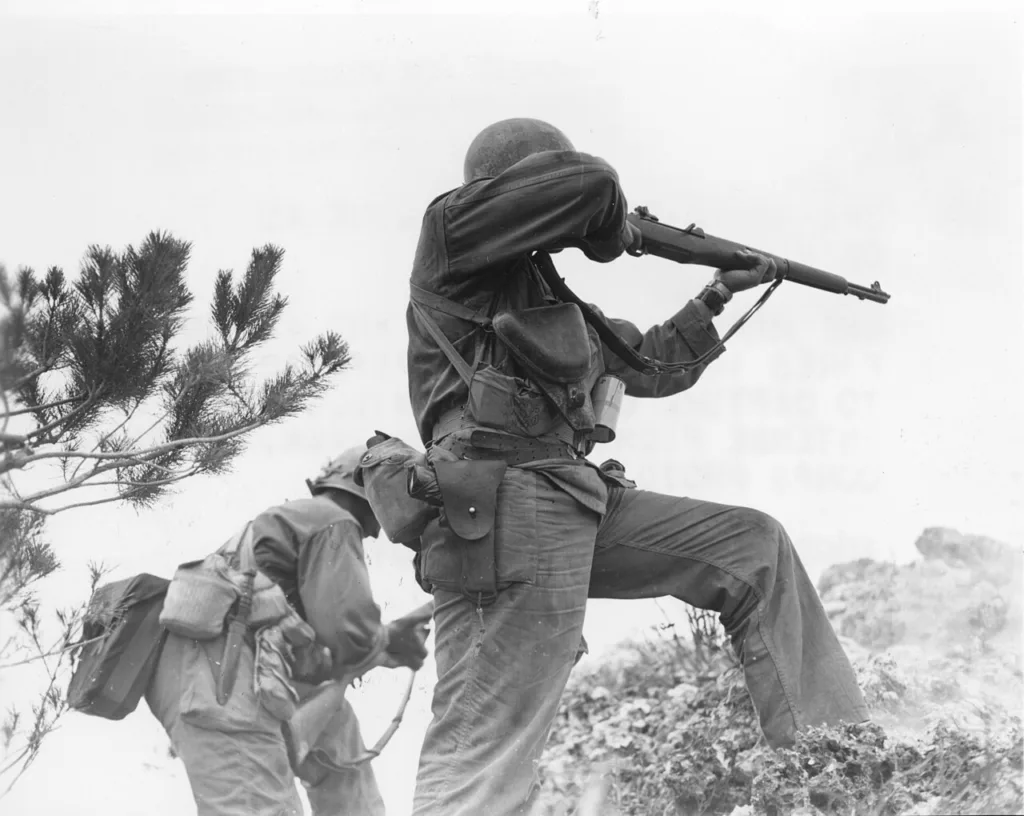
On the night of 21 May, in an attack on high ground near Shuri, Doss stayed out in the open treating the wounded while the rest of his company took cover, until a grenade explosion badly wounded him in the legs. Rather than call another aid man out of cover, he treated himself and waited five hours for the stretcher-bearers. On the way back, seeing a more seriously wounded man nearby, he climbed off the stretcher and told the bearers to take the other man first. While he waited for them he was hit again, and a sniper’s bullet shattered his arm. He bound a rifle stock to it as a splint and crawled 300 yards over rough ground to the aid station. He was evacuated that day aboard the hospital ship USS Mercy.
The Medal of Honor
On 12 October 1945 President Harry S. Truman presented Doss with the Medal of Honor at the White House. The citation ends by saying that his name had become “a symbol throughout the 77th Infantry Division” for gallantry. Besides the Medal of Honor he received two Bronze Stars for valour, three Purple Hearts and the Asiatic-Pacific campaign medal with three campaign stars and the arrowhead for an assault landing. He was the first of only three conscientious objectors to be awarded the Medal of Honor.
After the war
Doss had hoped to go back to carpentry, but the wounds to his arm made that impossible. In 1946 he was found to have tuberculosis, contracted on Leyte; he spent five and a half years in treatment and lost a lung and five ribs before leaving hospital in 1951. He and Dorothy raised their son, Desmond Jr., on a small farm in Rising Fawn, Georgia. Doss died at his home in Piedmont, Alabama, on 23 March 2006 and was buried in the Chattanooga National Cemetery in Tennessee. A stretch of US Route 501 in his home town is named the Pfc. Desmond T. Doss Memorial Expressway, and his story was told in the documentary The Conscientious Objector (2004) and the feature film Hacksaw Ridge (2016).
More: Audie Murphy · Witold Pilecki · all heroes of the war