
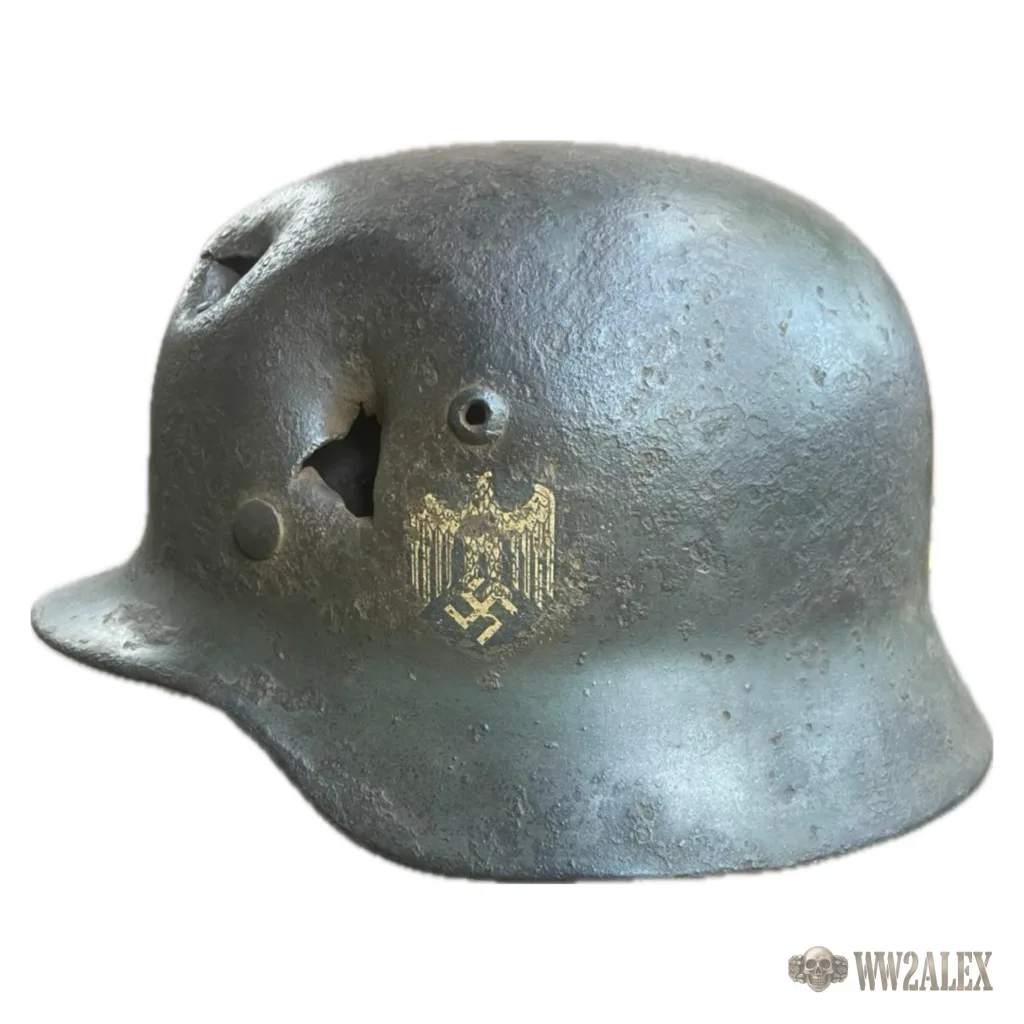
The Battle of Stalingrad was fought from 17 July 1942 to 2 February 1943 on the Volga and the Don. It ended with the destruction of the German 6th Army and is widely seen as the turning point of the war in the East. Many of the helmets and relics we list were recovered on its battlefields, from villages on the Don to the outskirts of the city.
Why Stalingrad
Germany’s summer offensive of 1942, Case Blue, was aimed above all at the oil fields of the Caucasus. Stalingrad, a large industrial city on the Volga, guarded the flank of that advance and the river traffic that carried oil north. In late July Hitler made the capture of the city itself an objective. The task fell to Army Group B, with General Friedrich Paulus’s 6th Army and General Hermann Hoth’s 4th Panzer Army.
The fight for the city
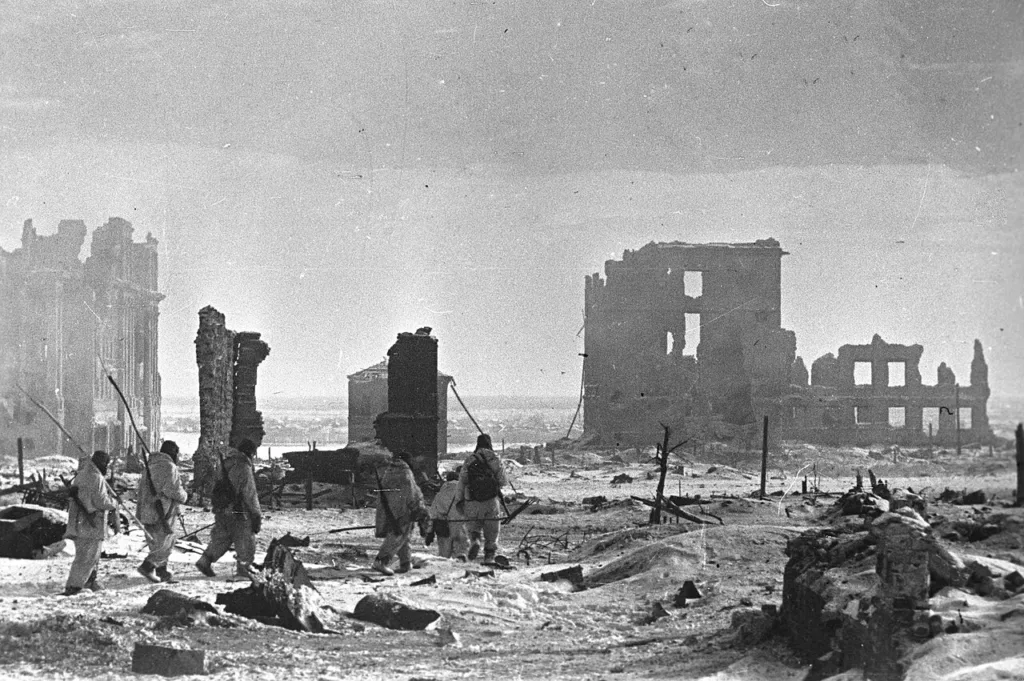
On 23 August 1942 German forces reached the Volga north of the city, and a massive air raid the same day destroyed much of Stalingrad. From September the battle became a struggle for streets, factories and single buildings. The Soviet 62nd Army under General Vasily Chuikov held a strip of the west bank, supplied across the river at night, and kept its lines close to the Germans so that German aircraft and artillery could not strike without hitting their own men.
Places from those months became symbols: Mamayev Kurgan, the hill over the city that changed hands several times; the Tractor, Barrikady and Krasny Oktyabr factories; and “Pavlov’s House”, an apartment building held by a small group of soldiers for about two months. The sniper Vasily Zaitsev fought here with the 284th Rifle Division.
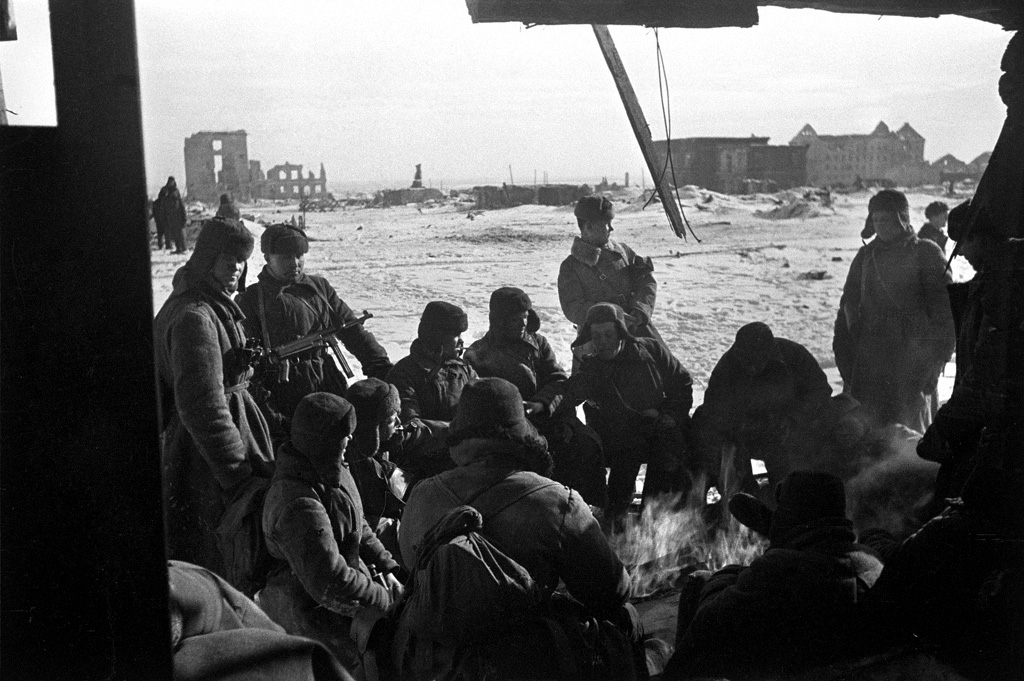
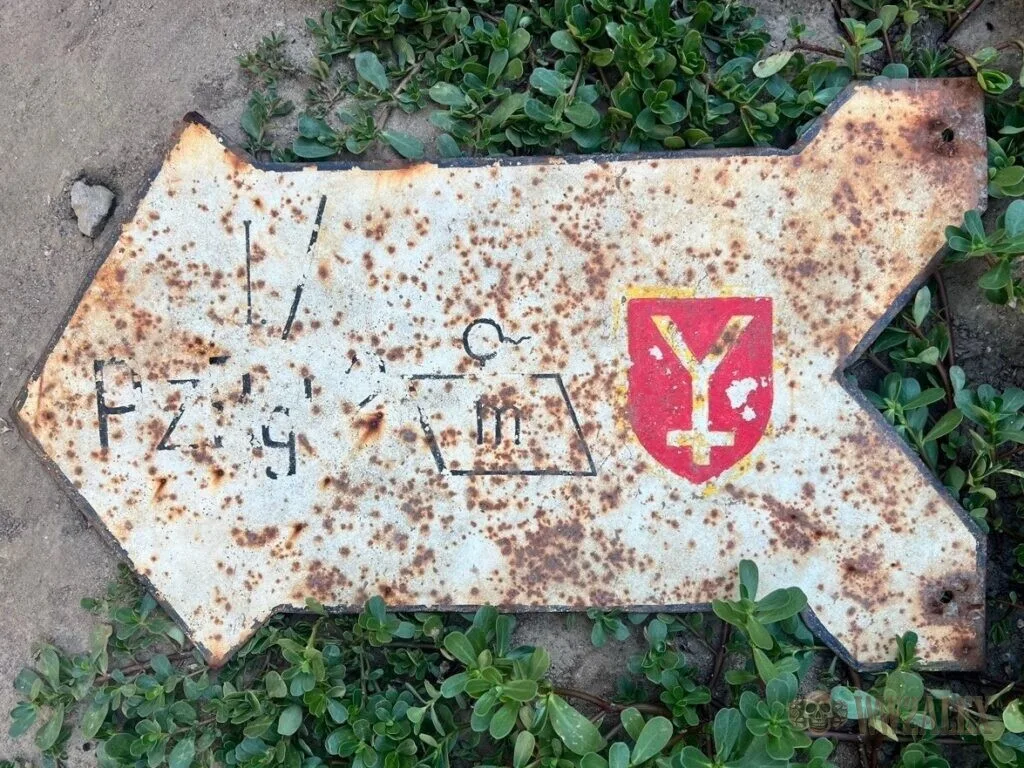
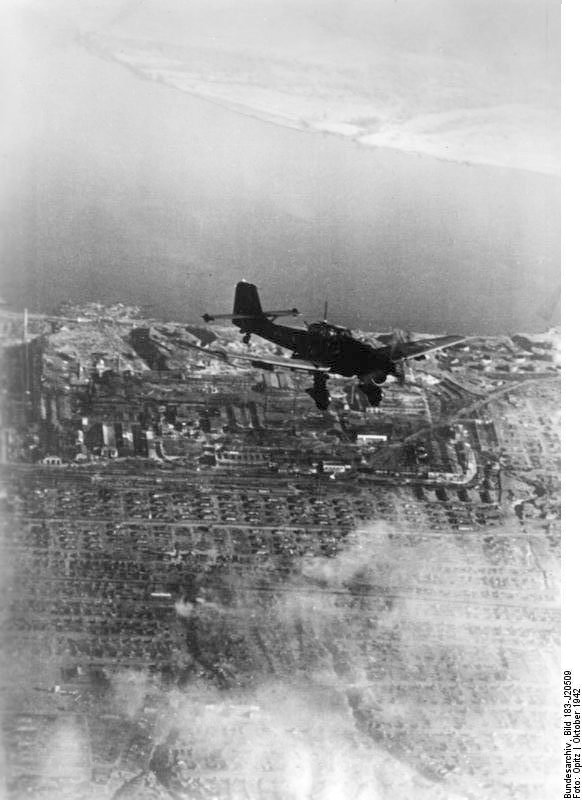
Fire from the air, 23 August 1942
On 23 August 1942, the day German tanks broke through to the Volga at Rynok and Spartanovka north of the city, General Wolfram von Richthofen’s Luftflotte 4 dropped some 1,000 tonnes of bombs on Stalingrad. Whole districts of wooden houses burned, oil tanks on the riverbank exploded, and the city centre was largely destroyed. One of the first units to stand in the way of the German tanks was the 1077th Anti-Aircraft Regiment, whose gun crews – many of them young women – lowered their barrels and fired at the tanks over open sights. The Stalingrad Tractor Factory went on turning out T-34 tanks, which drove straight from the assembly lines into battle, until German troops burst into the plant.
Across the Volga: the 13th Guards
By mid-September German troops had broken into the centre of the city and were close to the central landing stage, through which the 62nd Army received everything it needed. On the night of 14–15 September Major General Alexander Rodimtsev’s 13th Guards Rifle Division was ferried across the Volga under fire and went straight into battle. Its battalions fought for the central railway station, for Mamayev Kurgan and for the buildings along the embankment; the Univermag department store on Red Square served as the headquarters of the 1st Battalion of the 42nd Guards Rifle Regiment. It was from this regiment that Sergeant Yakov Pavlov’s group took the house on 9 January Square that became known as Pavlov’s House.
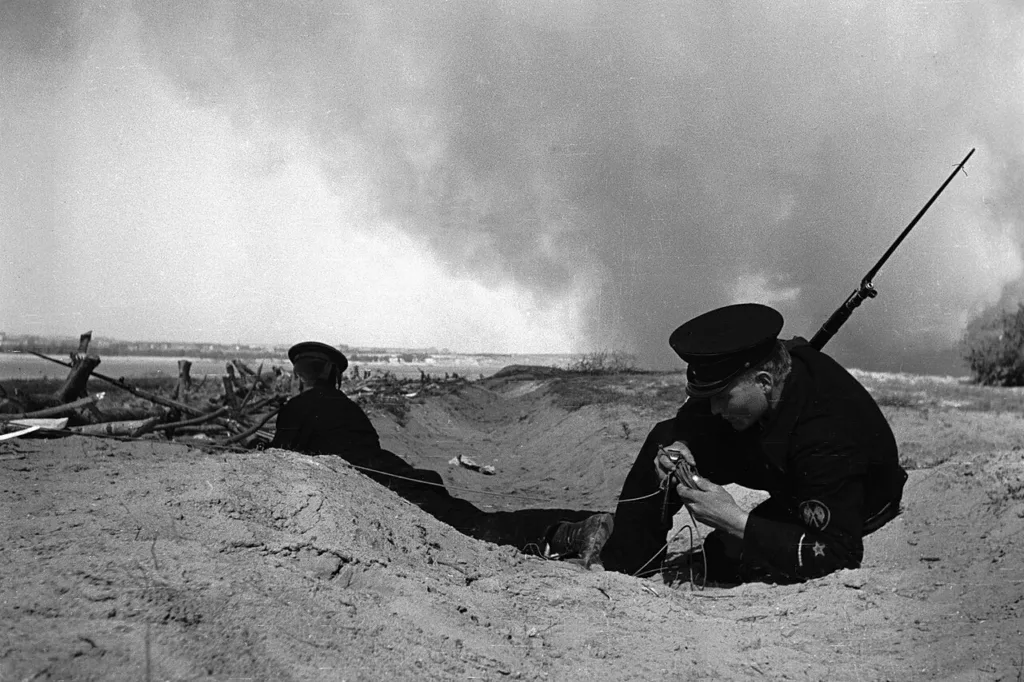
In the south of the city a ferocious battle raged for several days around the giant grain elevator. Ships and boats of the Volga Military Flotilla carried troops, ammunition and food across the river every night and took the wounded back to the east bank, under constant bombing and artillery fire.
The factory district
From October the heaviest fighting moved north, to the great factories that lined the river: the Tractor Factory, the Barrikady gun works and the Krasny Oktyabr steel plant. The Germans attacked them with fresh divisions, combat engineers and massive air support, and Soviet troops fought in workshops, cellars and furnace halls. By November the area still held by the 62nd Army had shrunk to a few strips of land along the western bank of the Volga, in places only a few hundred metres deep. The army did not give them up, and its stand in the ruins gave the Soviet command the time it needed to prepare the counter-offensive.
Operation Uranus: the encirclement
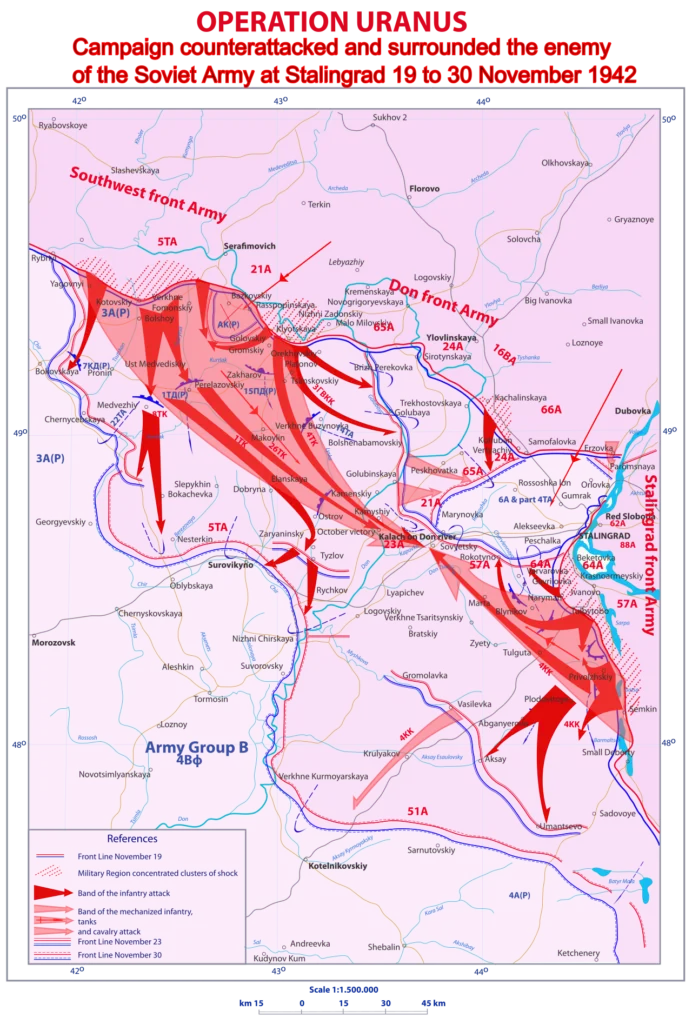
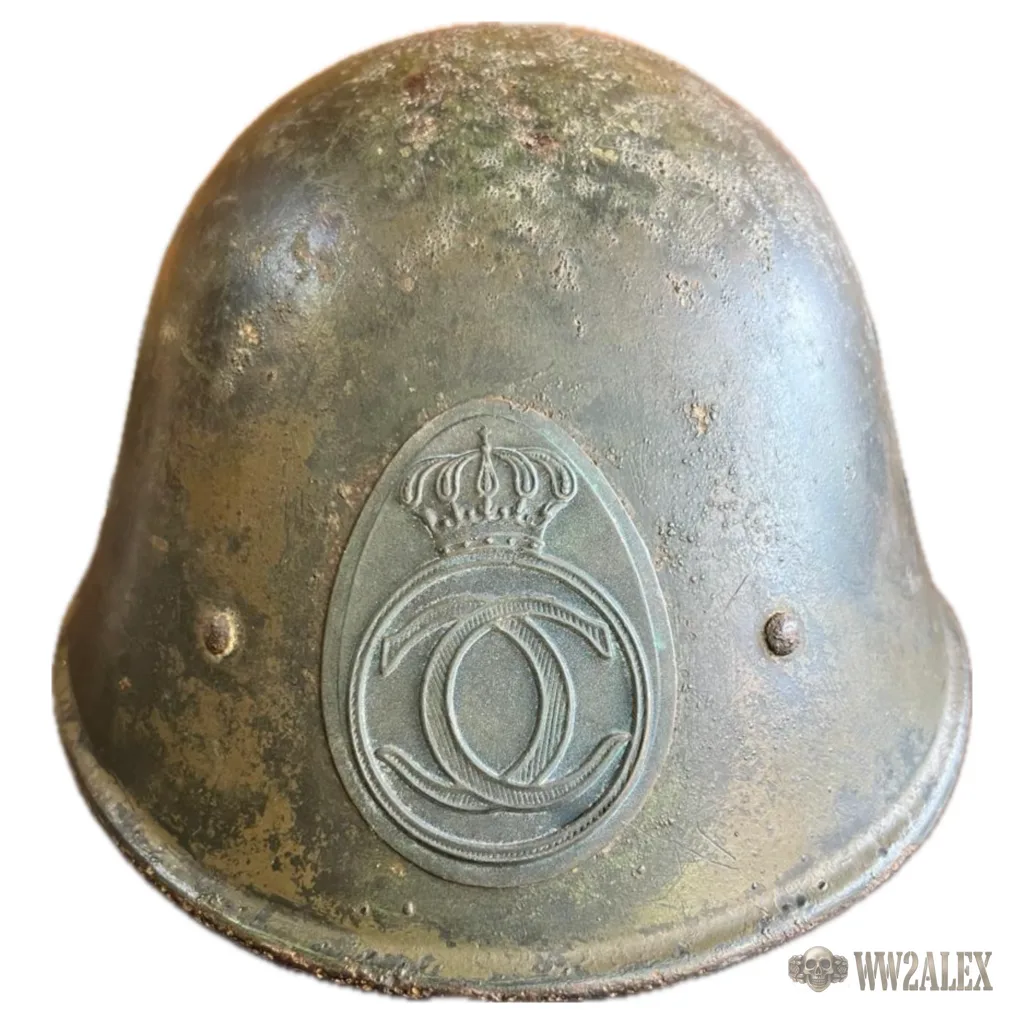
While the city fighting drew in German strength, the Soviet command prepared a counter-stroke against the long flanks, which were held largely by Romanian troops. On 19 November 1942 the South-Western and Don Fronts attacked from bridgeheads on the Don around Serafimovich and Kletskaya, breaking through the Romanian 3rd Army; the next day the Stalingrad Front struck from the south against the Romanian 4th Army. On 23 November the two pincers met near Kalach. Some 250,000 to 330,000 Axis soldiers were trapped in the pocket.
The pocket and the surrender
The Luftwaffe could not supply the encircled army by air. In December Field Marshal Erich von Manstein’s relief attempt, Operation Winter Storm, came within about 50 kilometres of the pocket before it was called off, while the Soviet Operation Little Saturn broke the Italian and Romanian positions further up the Don. On 10 January 1943 the Don Front under General Konstantin Rokossovsky began Operation Ring (Koltso) to destroy the pocket. The airfields at Pitomnik and Gumrak fell, and the pocket was split in two.
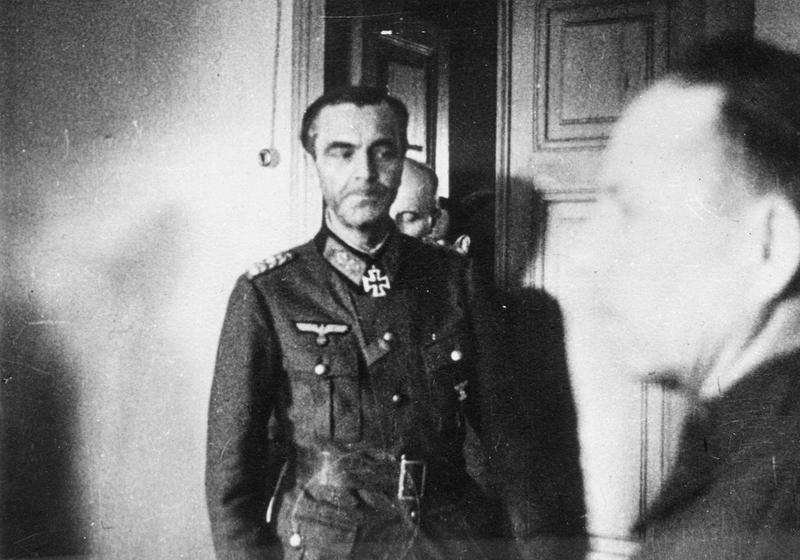
Paulus, promoted to field marshal on 30 January, surrendered with the southern group on 31 January 1943. The northern group under General Karl Strecker laid down its arms on 2 February. About 91,000 men, among them 22 generals, went into captivity; only a few thousand of them returned home after the war.
The cost
Casualties at Stalingrad were among the highest of any battle in history. Soviet losses, according to the statistical study edited by G. F. Krivosheev, were about 1.1 million, of whom about 480,000 were killed or missing. Axis losses, counting German, Romanian, Italian and Hungarian forces, are put at between 800,000 and 1.5 million killed, wounded, missing and captured. The civilian population of the city suffered terribly.
Today the battlefield is commemorated by the memorial complex on Mamayev Kurgan in Volgograd, as the city has been called since 1961.
See items recovered on the Stalingrad battlefields in our shop, and the guides to German, Soviet and Hungarian and Romanian helmets.
Sources and further reading
- Battle of Stalingrad – Wikipedia
- Operation Uranus – Wikipedia
- Antony Beevor, Stalingrad (1998).
- G. F. Krivosheev (ed.), Soviet Casualties and Combat Losses in the Twentieth Century (1997).
Written by WW2ALEX from the sources listed above.