Two groups of German awards are closely tied to particular battles of the Second World War: the Eastern Medal for the first winter in Russia, and the arm shields made for individual campaigns – Narvik, Cholm, Demyansk, the Crimea and the Kuban. This guide explains what each one commemorates, who received it and what it looks like.
The Eastern Medal, 1941/42
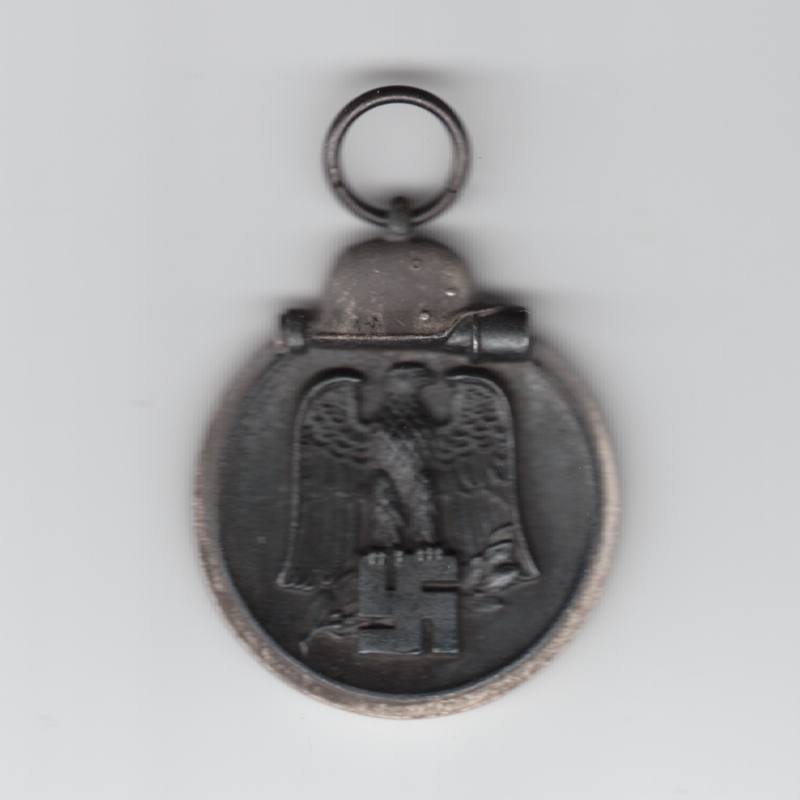
The Medal for the Winter Battle in the East 1941/42 (Medaille Winterschlacht im Osten 1941/42), usually called the Eastern Medal (Ostmedaille), was instituted on 26 May 1942. It went to members of the Wehrmacht and the Waffen-SS who served on the Eastern Front between 15 November 1941 and 15 April 1942 – the first winter of the war in the Soviet Union, when the German armies were stopped before Moscow and driven back.
To qualify, a soldier needed 14 days in active combat, or 60 days of continuous service in the combat zone; airmen needed 30 combat sorties. A wound or a frozen limb serious enough to earn the Wound Badge also qualified, and the medal could be awarded posthumously. From January 1943 eligibility was extended to non-combatant personnel, to foreign members of Wehrmacht units and to civilians working under Wehrmacht control. Awards ended on 4 September 1944. More than three million medals were issued, and soldiers gave it the grim nickname “the frozen meat medal”.
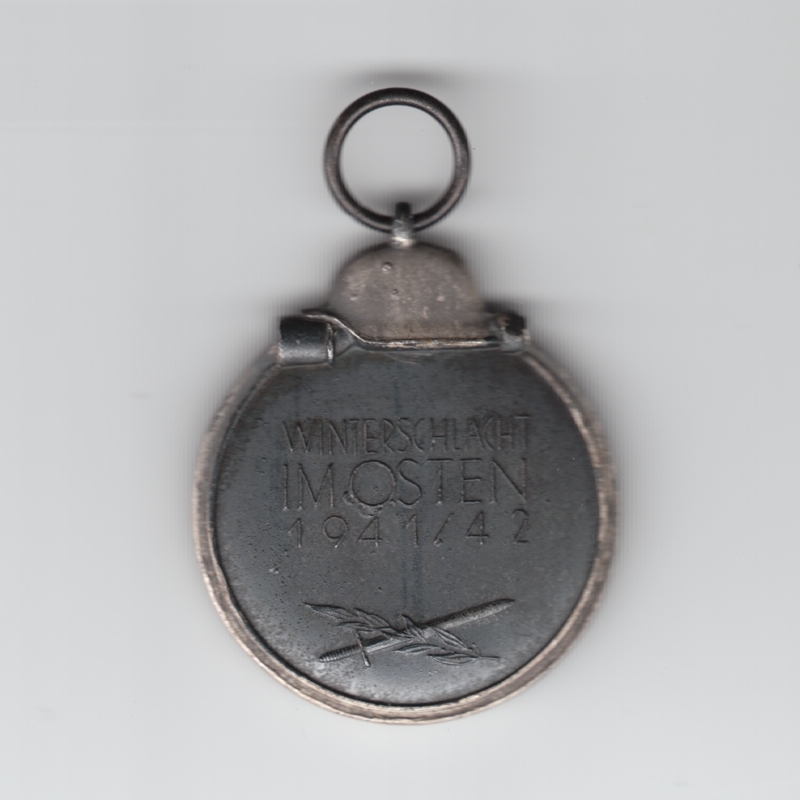
The medal was designed by Ernst Krause. It is about 3.6 cm in diameter, usually of zinc with a gun-metal finish. The front shows the eagle with laurel behind it; the back carries the words “WINTERSCHLACHT IM OSTEN 1941/42” above a crossed sword and branch. The helmet and stick grenade under the loop and the outer rim were polished to a silver effect. The ribbon is red with a central white–black–white stripe. The medal came in a paper packet with its name on the front and the maker’s name on the back, and the ribbon was worn in the second buttonhole of the tunic, behind the ribbon of the Iron Cross 2nd Class when a man had both.
The campaign arm shields
From 1940 Germany created a series of metal shields to commemorate particular battles. Each was worn on the upper left sleeve, fixed through a piece of cloth in the colour of the uniform. Collectors value them because each one records exactly where its owner fought.
Narvik, 1940
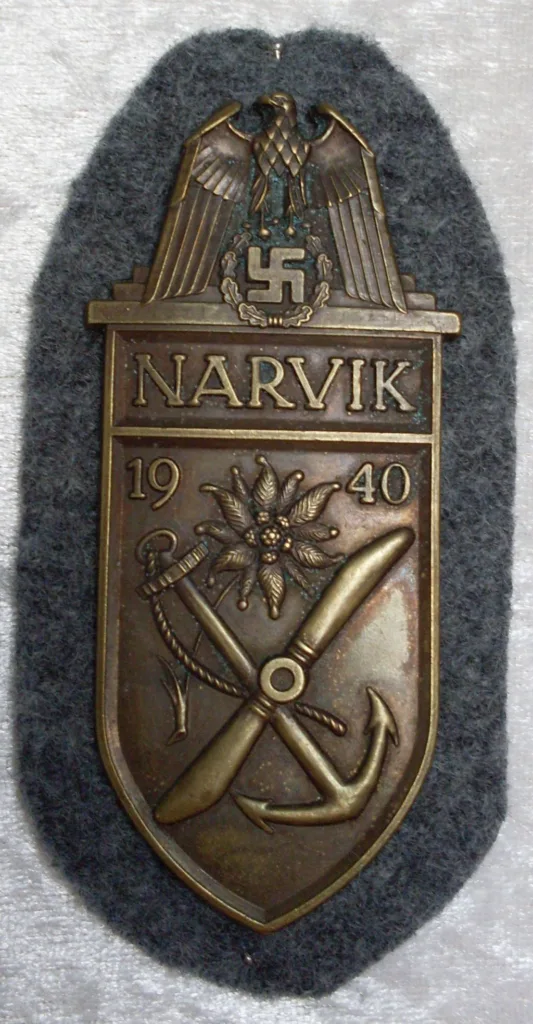
The Narvik Shield was the first of the series, instituted on 19 August 1940 for the German forces that fought at Narvik in northern Norway between 9 April and 8 June 1940, under General Eduard Dietl. It was designed by Professor Richard Klein of Munich. The body of the shield shows an edelweiss for the mountain troops, an anchor for the navy and a propeller for the Luftwaffe, with the name NARVIK and the year 1940. In all 8,577 men received it: 2,755 from the army, 3,661 from the navy and 2,161 from the Luftwaffe.
Cholm, 1942
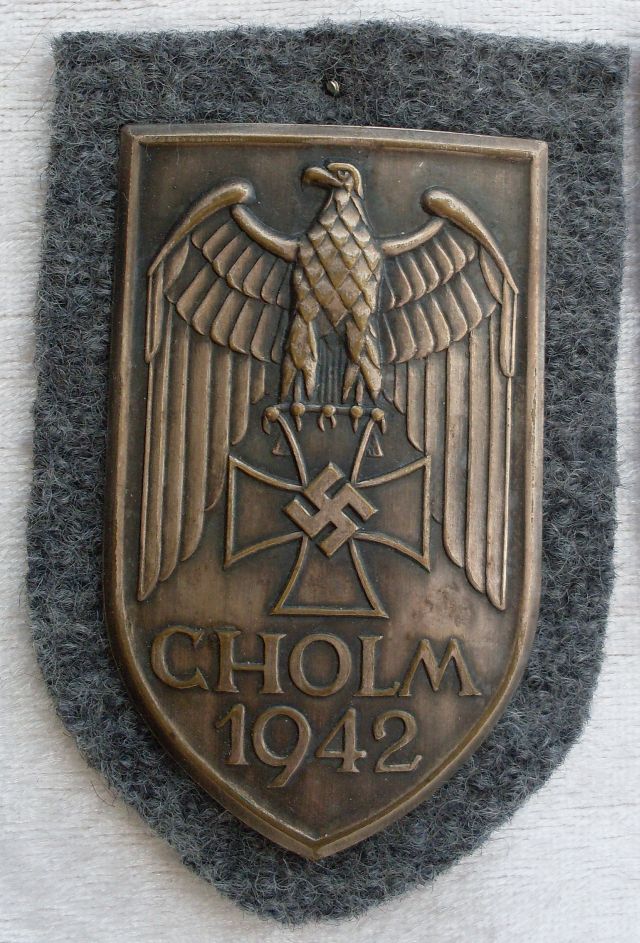
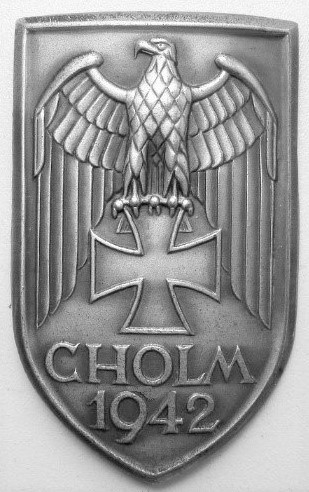
From 21 January to 5 May 1942 a small German garrison held out in the encircled town of Cholm (Kholm), supplied by air. The Cholm Shield was instituted on 1 July 1942 at the suggestion of the garrison commander, General Theodor Scherer. Its design came from Polizei-Rottwachtmeister Schlimmer, himself a veteran of the pocket, with small changes by Richard Klein: a large eagle holding an Iron Cross, with CHOLM and 1942 below. It is about 38 by 65 mm, of hollow stamped metal washed in silver. With about 5,500 recipients, it is the rarest of the German combat shields.
Demyansk, 1942
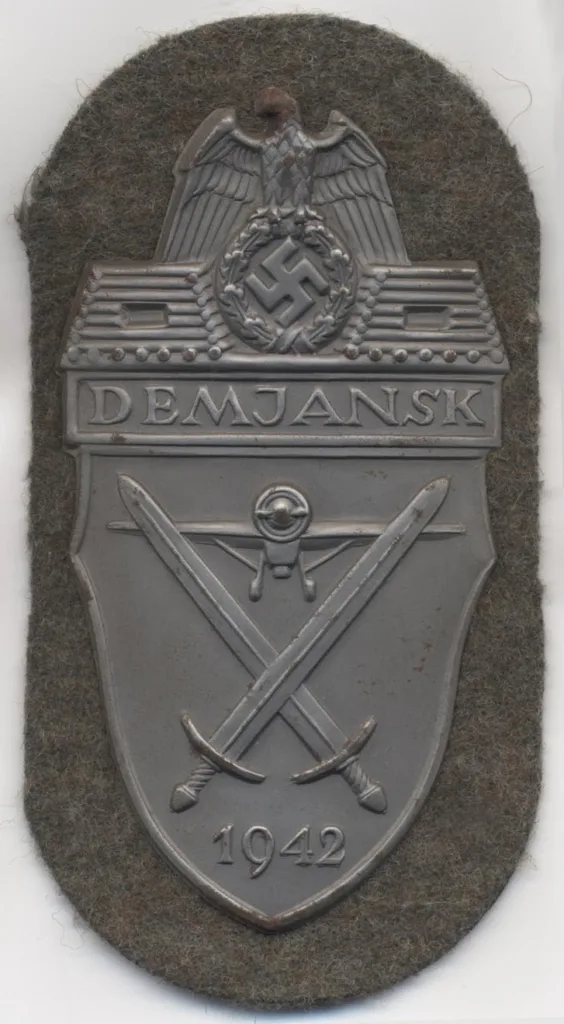
In the early months of 1942 the Red Army encircled a large German force around Demyansk, south of Leningrad. The pocket was held with the help of an airlift. The Demyansk Shield was instituted on 25 April 1943 and awarded until 1 July 1944. It was die-struck in silver-washed zinc, later plain zinc, and shows two log bunkers, the name DEMJANSK, a single-engined aircraft seen head-on behind two crossed swords, and the year 1942.
Crimea and Kuban, 1941–1943
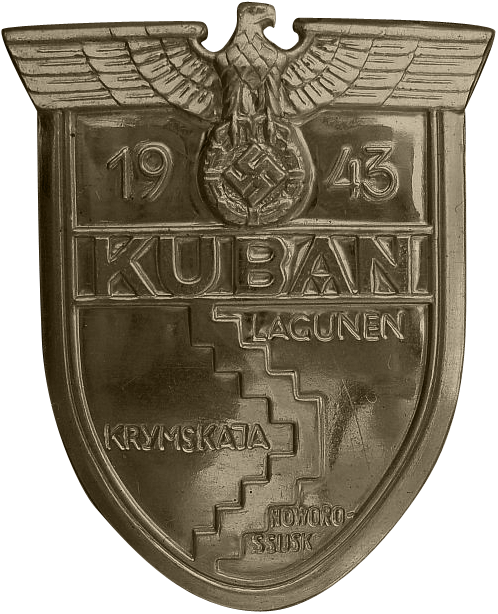
The Crimea Shield, for the fighting in the Crimea in 1941–1942, is described in our main German awards guide. The Kuban Shield, instituted on 21 September 1943, was awarded to the forces that held the Kuban bridgehead on the Taman peninsula, across the Kerch Strait from the Crimea, from February until it was given up in October 1943. It is similar in style to the Crimea Shield, in bronze-washed metal, about 52 by 62 mm, with the name KUBAN and a stylised map of the bridgehead marked with three places: Krymskaja, the lagoons and Novorossiysk.
After the war
In 1957 the Federal Republic of Germany allowed veterans to wear the Eastern Medal and the campaign shields again, redesigned without the swastika. These 1957 versions are post-war pieces. Modern copies of the shields are also common, so the construction, the back plate and the cloth backing all deserve careful attention.
More: German combat badges · the Wound Badge · the Battle of Moscow · awards and badges in the shop
Sources and further reading
- Eastern Front Medal – Wikipedia
- Narvik Shield – Wikipedia
- Cholm Shield – Wikipedia
- Demyansk Shield – Wikipedia
- Kuban Shield – Wikipedia
- John Angolia, For Führer and Fatherland: Military Awards of the Third Reich (1987).