German soldiers of the Second World War could earn badges for taking part in combat, not only for single acts of bravery. The three most common for the army on the ground were the Infantry Assault Badge, the General Assault Badge and the Close Combat Clasp. This guide explains who received each one, what the criteria were, and how the badges were made.
The Infantry Assault Badge
The Infantry Assault Badge (Infanterie-Sturmabzeichen) was instituted on 20 December 1939 by the Commander-in-Chief of the Army, Field Marshal Walther von Brauchitsch. It was awarded to soldiers of infantry and mountain infantry units of the Army and the Waffen-SS, and the award was approved at regimental level.
To qualify, a soldier had to have taken part, on at least three separate days from 1 January 1940, in infantry assaults or counter-attacks, in armed reconnaissance, in hand-to-hand fighting in an assault position, or in the recapture of combat positions.
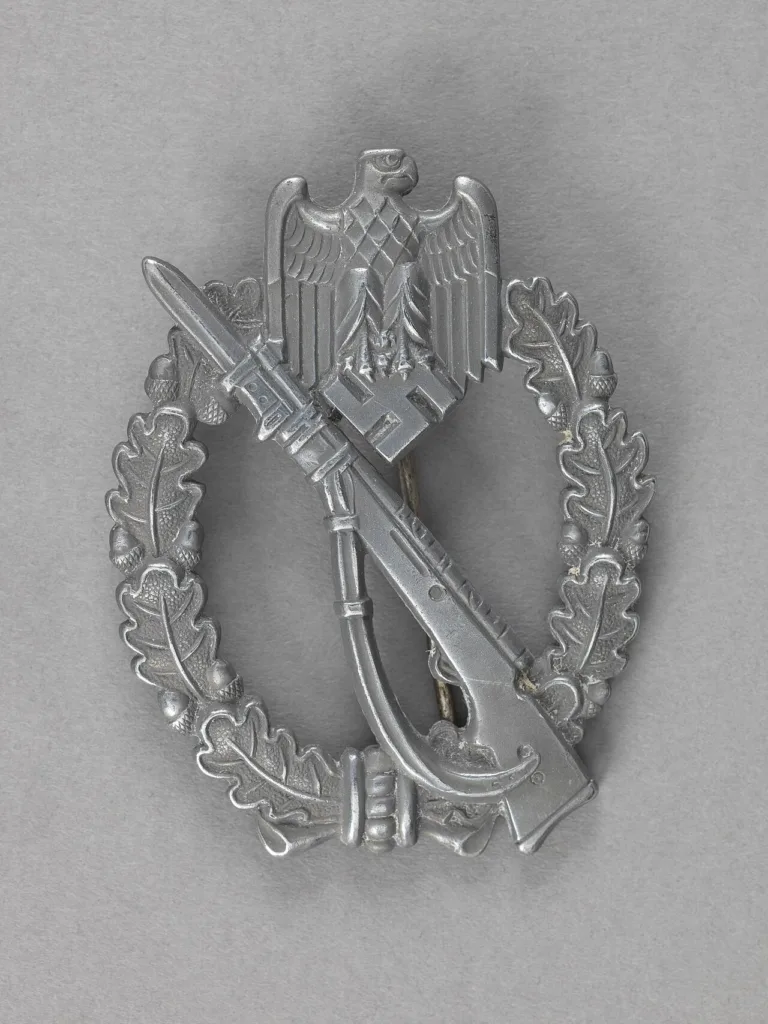
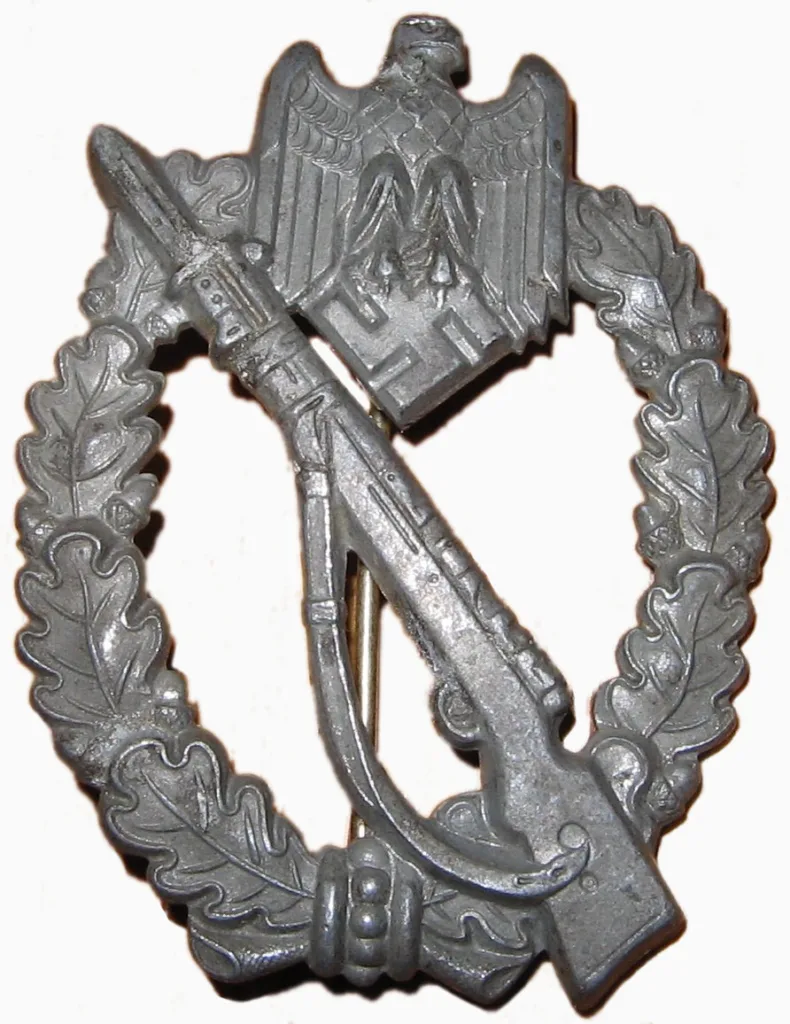
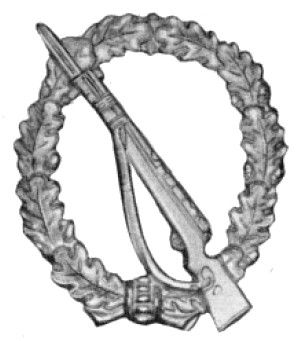
There were two classes. The silver class of December 1939 was for ordinary infantry. On 1 June 1940 a bronze class was added for motorised and mechanised infantry, with the same criteria. The badge was designed by the Berlin firm of C. E. Juncker: an oval wreath of oak leaves, with the national eagle at the top and a rifle with fixed bayonet across the centre. The back is plain with a pin. Early silver badges were silver-plated; later ones were made of zinc.
The General Assault Badge
Many soldiers fought alongside the infantry without belonging to it – combat engineers, artillerymen, anti-tank and anti-aircraft crews, and medical personnel working under close-combat conditions. For them, Brauchitsch instituted the General Assault Badge (Allgemeines Sturmabzeichen) on 1 June 1940. It went to men of the Army, the Waffen-SS and the Order Police who were not eligible for the Infantry Assault Badge and had taken part in three attacks on three different days. Until the Tank Destruction Badge was introduced in March 1942, it could also be awarded for destroying a tank single-handed.
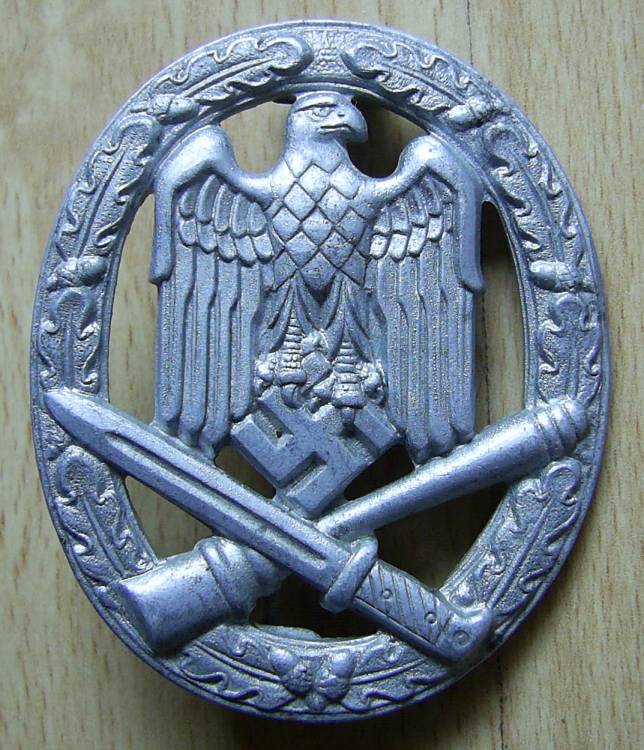
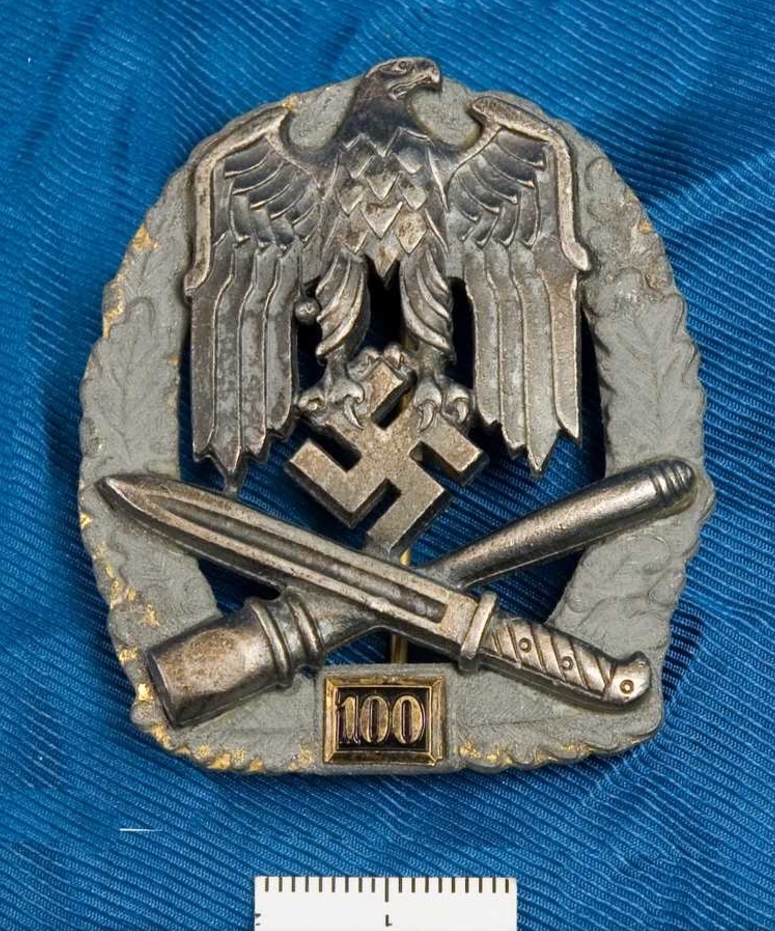
The badge was designed by the Berlin firm of Wilhelm Ernst Peekhaus. It is an oval of about 5.3 by 4.2 cm, with an oak-leaf wreath and, in the centre, an eagle above a crossed bayonet and stick grenade.
From 22 June 1943, higher grades recognised men who had taken part in many attacks. They carry a small plate at the base with the number 25, 50, 75 or 100. The badges for 75 and 100 attacks are larger, about 5.7 by 4.8 cm, with a gold wreath. Only the highest grade a soldier had received was worn.
The Close Combat Clasp
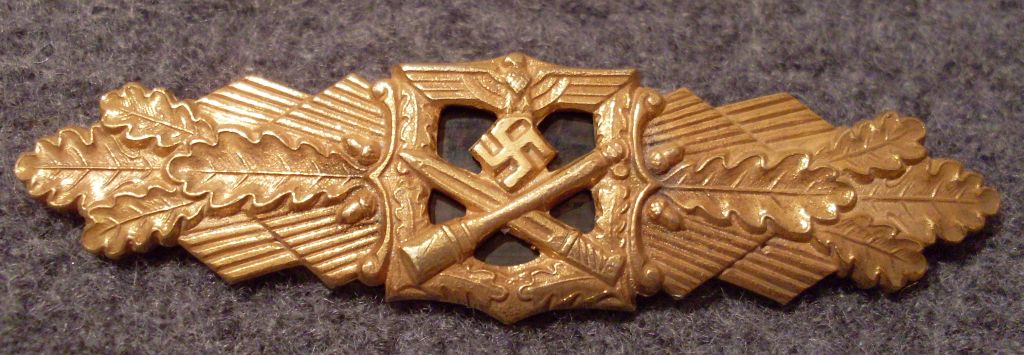
The Close Combat Clasp (Nahkampfspange) was instituted on 25 November 1942 for hand-to-hand fighting. It was meant mainly for the infantry, but men of the Army, the Waffen-SS, Luftwaffe ground units and paratroopers were eligible. It was worn above the left breast pocket.
There were three classes: bronze for 15 days of close combat, silver for 25 and gold for 50. Days were counted from 1 December 1942, and earlier long service on the Eastern Front counted towards the total: 15 months of continuous service counted as 15 days, 12 months as 10 and 8 months as 5. For men who had received disabling wounds, the clasp could be awarded after 10, 20 or 40 days.
After the war
In 1957 the Federal Republic of Germany allowed veterans to wear these badges again in a form without the swastika. These 1957 versions are post-war pieces, and collectors should be able to tell them apart from wartime badges.
Before you buy
- Check the material and finish against the type and period: plated early badges, zinc later in the war.
- Look at the back – the pin, the catch and the hinge, and any maker’s mark.
- Know the 1957 versions and modern copies; both are common.
- For the numbered General Assault Badges, check that the size and the colour of the wreath match the grade.
More: the Wound Badge · the Eastern Medal and campaign shields · Iron Cross, Panzer Badge and Crimea Shield · awards and badges in the shop
Sources and further reading
- Infantry Assault Badge – Wikipedia
- General Assault Badge – Wikipedia
- Close Combat Clasp – Wikipedia
- John Angolia, For Führer and Fatherland: Military Awards of the Third Reich (1987).